
STRIKES SUSPENDED
Ongoing Negotiations occuring
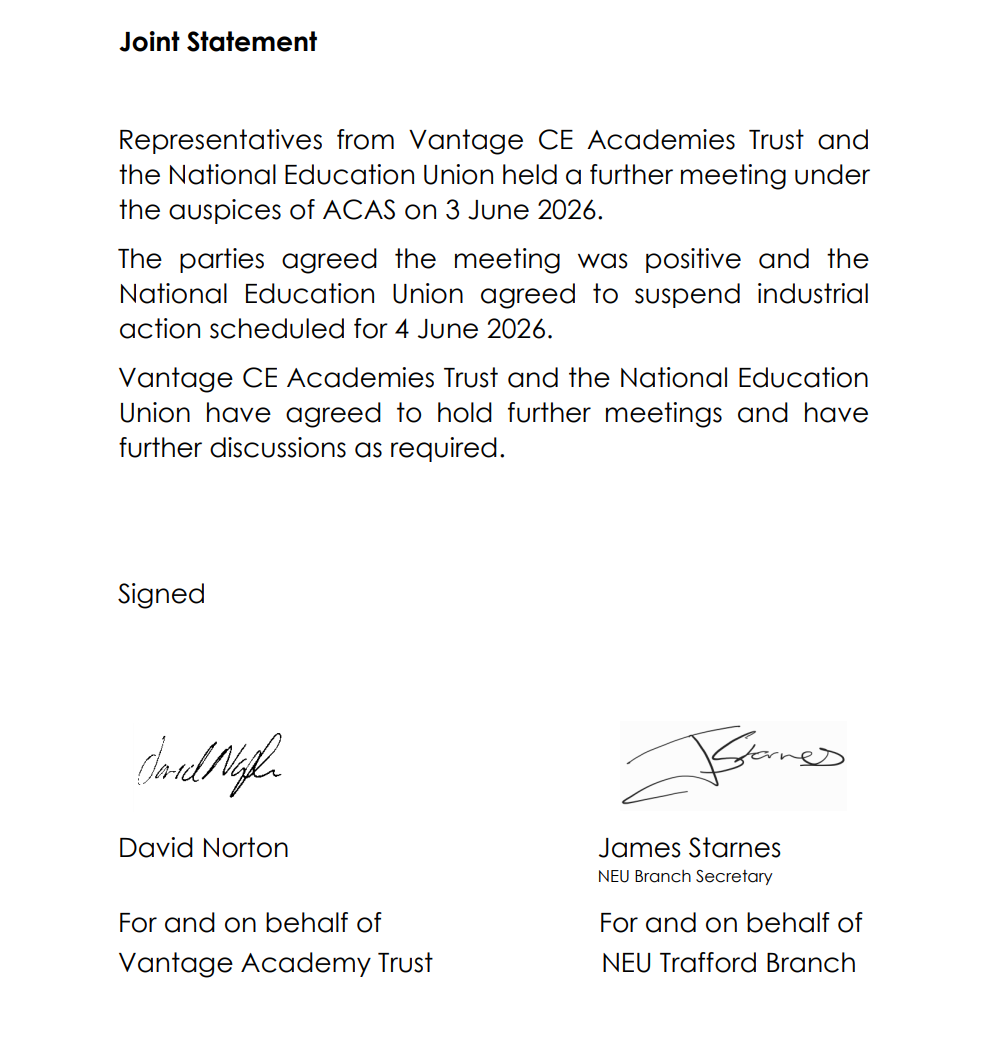
Ongoing negotiations will continue, and while the mandate for industrial action is still live, we have taken the move to suspend the action on 4 June 2026.
Flixton Girls School strike:
what parents need to know
Your child’s learning opportunities are being reduced – and staff are taking action to protect them.
Parents and students may have questions about the recent concerns raised by staff at Flixton Girls School and the ongoing FGS strike. This page explains why staff are taking action, how the situation affects students, and what the proposed changes mean for the school community.

A message to parents
We know strike action is disruptive, and we do not take it lightly. Staff are taking action because they believe these changes risk narrowing what students can learn and who will be there to support them. If you share these concerns, you can ask the school and trust to reconsider the proposals and to put students’ learning first.
Contact:traffordbranch@neu.org.uk
More info:neutrafford.org.uk/fgsstrike
Press releases:
https://www.neutrafford.org.uk/blog/release-flixton-girls-school-industrial-action
https://www.neutrafford.org.uk/blog/pr-fgs-rep-statement-1
https://www.neutrafford.org.uk/blog/open-letter-to-ceo-vantage-academy-trust-jill-messham

Confused about terms used?
Restructures and redundancies are laced with terms like compulsory redundancy, voluntary, modification orders…
Please look at our Redundancy and Restructure FAQ for a breakdown of what these terms really mean.
Protect curriculum time in Key Stage 3 so students build strong foundations.
Keep a broad and fair range of options at Key Stage 4 – especially where demand is high.
Ensure subjects are taught by specialists wherever possible.
Maintain meaningful pastoral support so every child is known and supported.
Avoid compulsory redundancies and reduce workload pressures that harm teaching quality
What staff are asking for

“As a student at Flixton Girls School,
… it is deeply upsetting seeing the people who shape our education, support our wellbeing and dedicate so much of their time to students face uncertainty due to cuts and redundancies. Teachers are far more than staff delivering lessons: they are mentors, role models, and a key reason we feel safe, supported, and motivated in school. The possibility of losing valued members of staff genuinely concerns me about the future of my education and school environment.
Many of the decisions being made do not appear to reflect students’ best interests. Proposed redundancies and staffing restructures risk increasing class sizes, reducing subject support, and placing additional pressure on the staff that remain. At a time when we are already dealing with exam stress and rising mental health pressures, removing experienced teachers and destabilising departments could seriously impact both educational standards and our wellbeing. It is difficult to understand how reducing support, consistency, and teacher availability could improve the learning environment at FGS.
It is also concerning that these cuts are being considered while the school is currently at a balanced budget, suggesting that financial savings may be being prioritised over educational need. Schools are not businesses, and decisions like this should be driven by what benefits students’ learning and wellbeing, not cost-cutting for its own sake. From my perspective, it is difficult to understand why valued staff are being placed at risk when financial resources appear to be available. Investing in staff is investing directly in students, and the current proposals raise serious questions about priorities within the school.
I am worried about the impact these cuts will have on subject choice and specialist teaching, particularly at KS4. Reducing staffing levels will limit GCSE options, subjects such as PE, Social Sciences, German, Psychology, Health and Social Care, and Performing Arts are at risk. This will significantly narrow students’ creative and academic choices and these changes will also result in fewer lessons being taught by subject specialists, which may affect the quality of teaching if staff are required to teach outside their areas of expertise. This not only restricts students’ ability to choose subjects that align with their interests and future goals, but also reduces the overall quality and consistency of learning. Access to a broad, high-quality curriculum is essential, and I am concerned that these decisions could significantly limit opportunities for both current and future year groups.
The atmosphere in school has already changed since these discussions began in February. Many students now feel anxious and unsettled, especially in exam years where consistency and support from trusted teachers is essential. This growing uncertainty about what our school structure will look like going forward has led to a clear increase in stress and anxiety not only from pupils but from staff too.
As a neurodivergent student, I also want to highlight the additional impact these changes have on students who rely heavily on routine, consistency, and trusted relationships within school. Sudden staffing changes and the loss of key support systems can not only affect our ability to learn and our academic performance, but also our confidence, wellbeing and wider mental health. I am concerned that this impact on neurodivergent and more vulnerable students is not being fully considered.
There are also serious practical concerns about how these reductions will work in reality, particularly as the school has had an increase in number of pupils throughout the last 3 years. I find it difficult to see how fewer teachers will be able to support a larger student body without affecting lesson quality, subject availability, intervention support, and staff workload. I am worried that the long-term consequences of these decisions have not been fully considered by a governing body that won’t be around to see the repercussions of their actions.
I strongly hope that alternatives to redundancies are properly explored and that the voices of both staff and students are genuinely taken into account before irreversible decisions are made. As a student directly experiencing the impact of these cuts, I feel that these changes risk significantly undermining the quality and stability of my education. I am asking that these plans are urgently reconsidered with genuine regard for the long-term educational impact on students. We deserve a stable, supportive, and well-resourced education, and teachers deserve to feel valued and secure in their roles. I am writing because I care deeply about the future of our school and the people within it. However, I feel that the current direction does not fully align with our core values of aspiration, respect, and resilience.
Failing Great Staff Fails Great Students.”
— Year 10 Student
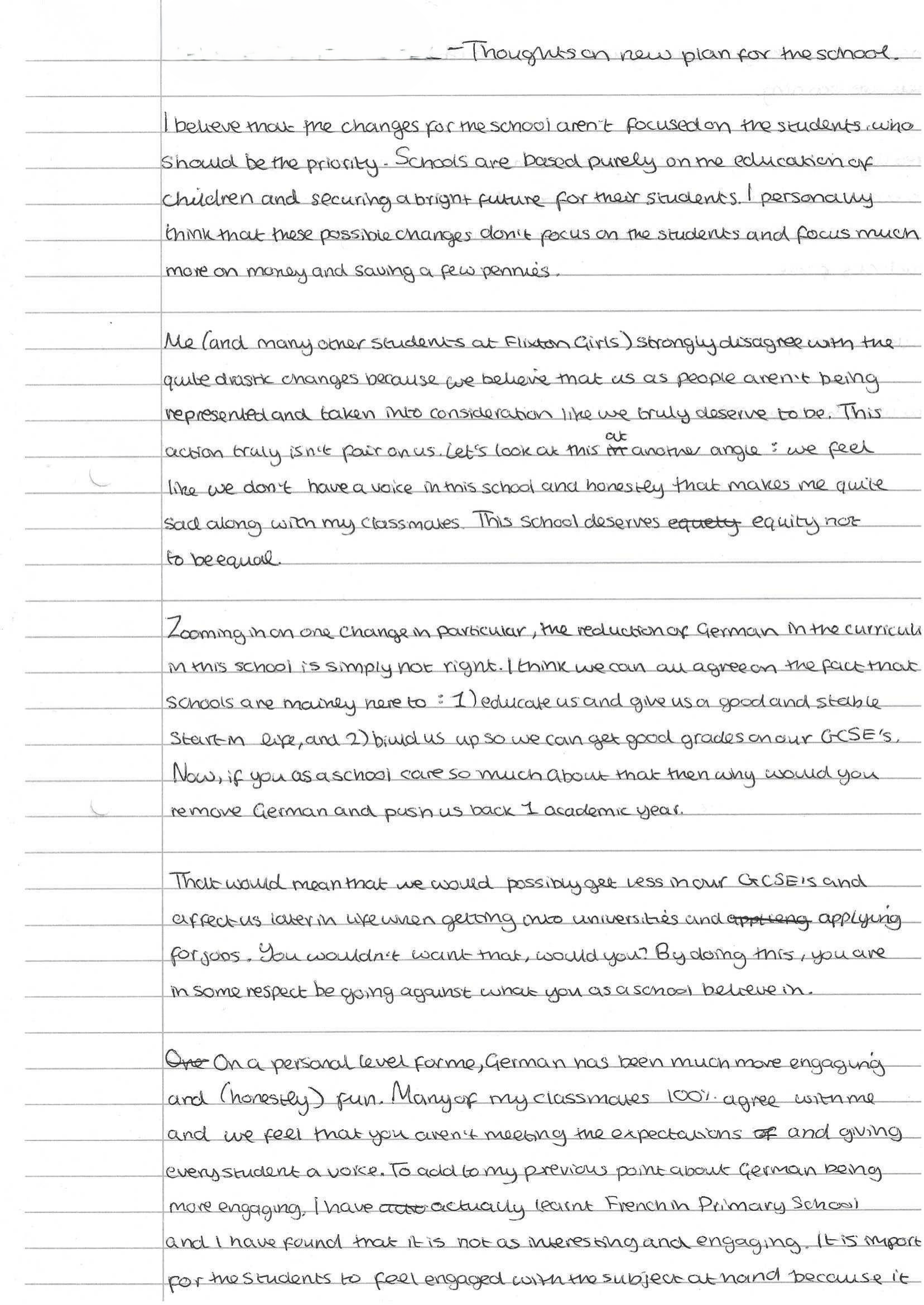
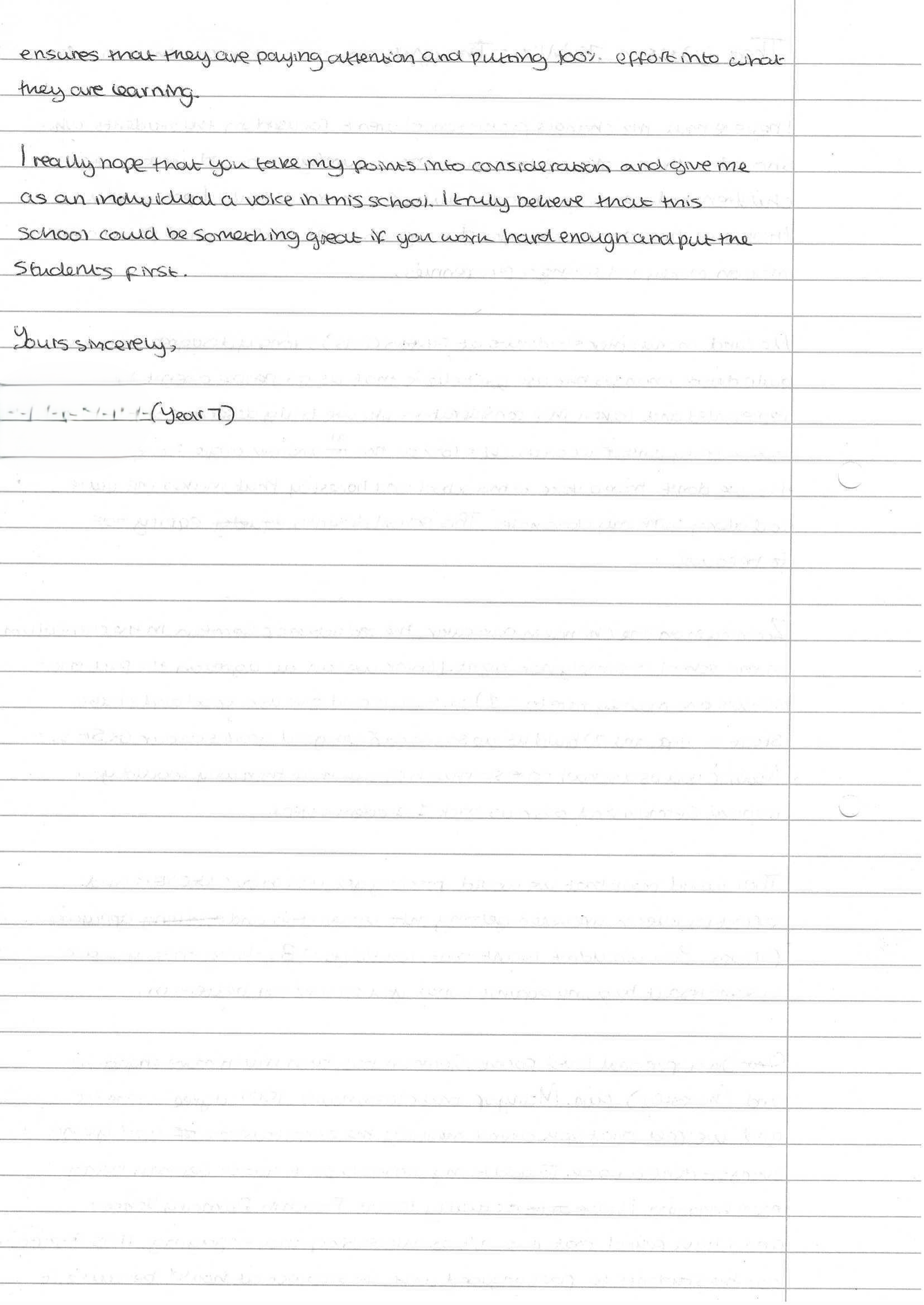
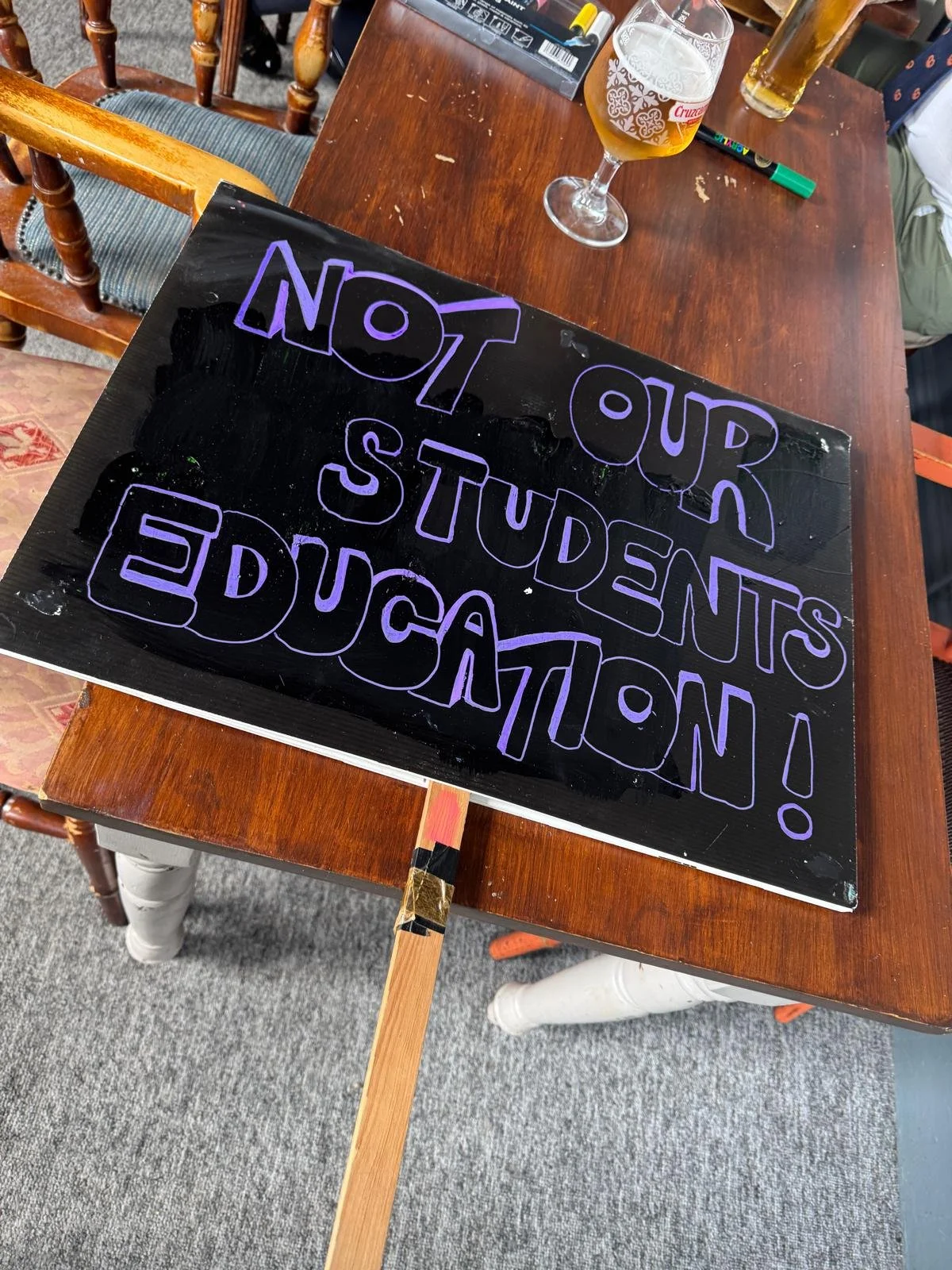
-A note handed to one of the striking teachers on 19th May by a Year 7 student
What are FGS Parents Saying?
“I am writing as a parent of a student at the school to express my support for the current strike action and, more importantly, to explain why I believe the concerns being raised by teachers are both reasonable and in the best interests of our children.
It is important to be clear that this action is not about pay rises or additional benefits. Teachers are asking for the basic conditions necessary to deliver a high‑quality education. These include having enough specialist teachers to teach specialist subjects, workload levels that allow staff to plan lessons thoroughly and mark work effectively, and a curriculum that is designed and led by subject experts rather than driven by short‑term cost savings.
As a parent, I want my daughter to have stability, consistent high‑quality teaching, and access to a curriculum that is properly resourced and supported. These are not unreasonable expectations; they are the foundations of a good education. When teachers are overstretched, when subjects are taught without appropriate expertise, or when decisions are made primarily on financial grounds rather than educational ones, it is ultimately students who lose out.
The current proposals do not appear to move the school toward these goals. Instead, they risk increasing instability, reducing educational quality, and placing further strain on staff who are already working under significant pressure. While I regret the disruption that strike action causes families, I believe the longer‑term impact of inaction would be far more damaging for students.
I urge those responsible for decision‑making to listen carefully to the concerns being raised and to engage constructively with staff to find solutions that prioritise students’ education over short‑term financial cuts. Supporting teachers is not separate from supporting students — the two are inseparable.
I hope that a resolution can be reached swiftly, one that ensures teachers have the conditions they need to teach well and students receive the education they deserve.”
— Parent of a Year 9 Student“I am a parent of a Year 10 student at Flixton Girls School and I wanted to write to express my full support for staff taking action to protect students’ education.
I am extremely concerned about the proposed redundancies, downgrading of roles, and cuts to GCSE options. These changes will clearly impact teaching quality, pastoral support, and the opportunities available to students.
My daughter studies Health and Social Care and her teacher is being made redundant. She is already anxious about next year, particularly as the replacement teacher covering the subject does not appear to have specialist knowledge. This teacher has also been an important source of support and encouragement for her personally.
As a dyslexic student who struggles with anxiety and confidence, experienced and supportive teachers make an enormous difference to her education and wellbeing. I am also worried about the loss of experienced English staff at a time when strong specialist teaching is vital.
I do not believe students should lose subject choices, specialist teaching, or pastoral support because of financial decisions within the trust. Every child deserves the opportunity to thrive academically and emotionally at school.
Thank you for standing up for staff and students.”
— Parent of a Year 10 Student“We chose Flixton Girls because of the clear love and passion all the teachers delivered into their lesson and the wide variety of choices. It is deeply concerning to me that the proposed changes could massively impact my daughters education and options and I thinks its absolutely horrific that this is happening, we chose the school because of these qualities and I wouldn't be happy with these just being taken away. We should be giving girls all the opportunities to be the best they can be and go on in to society to be something amazing, achieve great things and be incredible people. Why would these decisions be made that could massively impact so many lives amd futures?
My child, and all children deserves time, specialist teaching and a full range of opportunities. She also deserves crucial pastoral support whenever she may need it, these are some of the toughest years of life, going through puberty, dealing with friendships and exam stress, strong consistent pastoral support should be absolutely a priority.
At a time when teacher retention and recruitment is at an all time low, why would it be deemed acceptable in any kind of way to reduce planning time, take away specialists and force more workload onto less people in less time. That is not a sustainable business model, and anybody can see that.
I look forward to hearing of these proposals being revoked and the wellbeing of our teachers and the future of our girls coming first!“
— Parent of a Year 7 Student“I've been sent the link to the NEU article about Flixton Girls School and having read it, it strikes a chord with what we as parents are hearing via the pupils.
Lots of substitute teachers, reduced GCSE options, a focus on non-academic courses, a decline in language options.
I understand there are cost pressures for the school as with every school but if the school loses it's excellent educational reputation then it will no longer be a desirable school.
I wish you well with your action.“
— Parent of a Year 9 Student“I am a parent of a Year 7 pupil who attends FGS and I am deeply concerned about the Trusts proposals with regards to
- Cutting options at Key stage 4,
- Subjects not being taught be specialist teachers
- Reducing protected curriculum time in Key Stage 3
- Reducing pastoral support
- compulsory redundancies which will increase workload pressures and harm teaching quality.
We chose Flixton Girls because of the clear love and passion all the teachers delivered into their lesson and the wide variety of choices.
It is deeply concerning how the proposed changes could impact on my daughter’s, as well as all the other FGS student’s education. This is our future generation and we should be giving the girls the best possible start into adulthood. These years are key and the decisions that they make could lead the way and shape their future. We should be giving them the best possible opportunities for them to thrive and reach their potential.
My child, and all children deserves time, specialist teaching and a full range of opportunities. They deserve crucial pastoral support whenever they may need it, these are some of the toughest years of life, going through puberty, dealing with friendships and exam stress, strong consistent pastoral support should be absolutely a priority.
At a time when teacher retention and recruitment is at an all time low, why would it be deemed acceptable in any kind of way to reduce planning time, take away specialists and force more workload onto less people in less time. That is not a sustainable business model.
I look forward to hearing of these proposals being revoked and the wellbeing of our teachers and the future of our girls coming first“
— Parent of a Year 7 Student“I am very concerned about the information shared on your website and what this means for the quality of education my daughter will receive. She requires SEND support and this means that teachers have to have the time and energy to support her when needed. A burnt out, overworked, demoralised staff team can only impact the quality of her school experience in a negative way. Leaders need to look beyond spreadsheets and put pupils’ welfare and education first.”
— Parent of a Year 7 Student“I am writing as a parent of a Year 9 student at Flixton Girls School to express my wholehearted support for the teachers taking strike action.
As a parent, it is not easy to see disruption to our daughters’ education, but it is even harder to ignore the reasons why dedicated teachers feel they have no other choice. I want to recognise, with genuine gratitude, the personal and financial sacrifices being made—especially so close to the summer holidays. That speaks volumes about the depth of care teachers have for our children and their future.
My daughter, like all the girls at Flixton, deserves an education that opens doors rather than quietly narrows them. That means protecting the richness of the curriculum, ensuring subjects like languages continue to be offered with a variety of choice, that there is enough time in Key Stage 3 to build real confidence and understanding, and that by Key Stage 4, students are not faced with reduced or unfair choices, particularly in the subjects they care most about.
It also means being taught by passionate subject specialists who inspire a love of learning and having strong pastoral support so that every girl feels seen, valued, and supported as she grows—not just academically, but personally.
Above all, I am deeply concerned by the impact that increasing workload and the threat of redundancies have on the stability and quality of education. When teachers are stretched too thin, it is our children who inevitably feel the consequences.
These girls are at a crucial stage in their lives. The education and support they receive now will shape their confidence, their opportunities, and the paths they believe are open to them. That is why this matters so much.
I stand with the teachers of Flixton Girls School in asking for the resources, conditions and respect needed to protect the education our daughters deserve.
Thank you to the union for your continued efforts on behalf of both staff and students.”
— Parent of a Year 9 Student“I am writing as a parent of a year 11 student who is due to leave this school shortly. I fully support the strike action currently being taken and proposed in the future. This is necessary to protect the high standard of education provided to students in the school.
Cuts to staffing, redundancy of specialist roles, reduction in essential pastoral support are all being implemented by the Vantage Academy Trust which currently runs the school.
Parents have received very limited information from the trust about these proposed changes. The trust appears to be hiding its true intentions to reduce costs and save money.
I strongly oppose the proposed cuts. The school needs ongoing growth and enhancement, investment in specialist teachers, proposals which genuinely help our children with issues of education and personal growth.
Reducing pastoral support, specialist roles and subject options is a detrimental and damaging proposal.
I am writing for future children and the dedicated staff. My daughter will shortly leave school and future years of children require your attention and support to ensure the school trust is not allowed to put financial gain over children's futures.
I hope you can support the staff strike and demand the trust is accountable.
Thank you”
— Parent of a Year 11 Student“I am writing to protest about the proposed staffing and curriculum changes at Flixton Girls School.
My daughter is in Year 7 and the features that attracted us to the school were the impressive pastoral system, the expertise of the staff and their enthusiasm for their subjects and the breadth of subjects and activities on offer. It is very worrying to learn that these things are now under threat.
In particular, I am very unhappy about the proposed reduction in language choice and lesson time. This would affect my daughter's year the most since they would be expected to start a new language from scratch in Year 8 AND have a reduction in hours to 3 hours per fortnight, whereas typical local schools receive 5 hours. As a graduate of Modern Languages myself, I know the importance of frequent practice in order to build fluency and confidence and the proposed changes would leave the girls at a severe disadvantage compared to their peers in other schools, This is absolutely not acceptable and is bound to have an affect on GCSE results.
It is also not acceptable that certain subjects may be taught by non-specialist staff and subject lead roles may be removed in Humanities. Again, pupils would be disadvantaged by this and it is bound to affect results.
I am very displeased to read that putting the proposed plans into action would actually move the school into surplus, so it is evident that these cuts are not all necessary. I would like to add that I wholly support the staff in their strike action and would like to thank the Union for your efforts to prevent these changes being brought into effect.“
— Parent of a Year 7 Student“I am contacting you regarding the potential removal of German from the school curriculum. My daughter has been extremely disappointed since hearing this news. She has developed a genuine enthusiasm for the subject and even completes additional Duolingo lessons at home because she enjoys it so much.
When she started last September, she was thrilled to learn that German would be her language option, and it has had such a positive influence on her confidence and engagement in school. It would be a real shame for students to lose access to a subject that has clearly inspired them and broadened their learning experience.
I would be grateful if you could share any further information about this decision and whether there may be opportunities to keep German available for the students who are passionate about continuing.
This is just one of the issues that are being raised within the strike action and the majority of the parents are concerned as to how this will impact our children in the future. The variety of subjects in which the school currently offers is what drew me and many other parents and daughters to the school initially.
Thank you for your time and consideration.”
What Your Teachers Are Saying

Core subjects
What your teachers feel: We are worried that families are being told there is more time for core subjects without being shown the full picture. At Key Stage 3, English seems to gain time mainly because separate literacy time has been absorbed into English, not because students are getting more teaching overall. We are also concerned that if additional support capacity in Key Stage 4 English, maths and science is reduced, class sizes could rise and students may get less support when they need it most.

Health and social care, sociology and psychology
What your teachers feel: We are concerned about the future of health and social care, sociology and psychology. Our concern is that these subjects could continue without the specialist teaching and leadership that helps students succeed in them. Families are entitled to ask how these courses can be maintained at a high standard if they are no longer taught and led by subject specialists.

PSHE
What your teachers feel: PSHE is currently planned by a specialist lead and delivered by experienced staff. Under the proposed changes, it appears that responsibility may be spread more widely across the school. We are concerned that sensitive topics such as misogyny, consent, puberty and healthy relationships may not then be taught with the same consistency and expertise.
What your teachers feel: At a time when Ofsted and the Department for Education are placing increasing importance on PSHE, we believe families may reasonably worry about any change that appears to weaken its quality or consistency rather than strengthen it.

Languages
What your teachers feel: We are concerned that describing the change from two languages to one as “streamlining” may understate what it means for students. In practice, this is not about simplifying a system where pupils study two languages at once. It is a significant reduction in language choice and lesson time, and families deserve a clear explanation of what that could mean for students’ progress and future opportunities.
What your teachers feel: Learning a language depends on regular lesson time and practice. One local comparator school provides 4 hours, while many nearby schools provide 5–6 hours. Under the proposed model, students would receive only 3 hours a fortnight. That is up to 100% less time than some comparable schools, and we believe that gives students fewer opportunities to build fluency, confidence and long-term success.
| School model | Periods per fortnight | Difference compared with 3 periods |
|---|---|---|
| Proposed model | 3 | — |
| Typical local schools | 5 | +67% |
| Strong comparator schools | 6 | +100% |
What your teachers feel: The evidence we have seen points the other way. Students who previously had 4 hours a fortnight across Key Stage 3 have gone on to achieve strong outcomes. That is why we are concerned about reducing a model that appears to support stronger progress.
What your teachers feel: We are worried that this change may be being shaped by practical staffing pressures rather than by what is best for students’ learning. If pupils are expected to reach the same standard as peers elsewhere with far fewer teaching hours, we do not believe that is fair on them.
What your teachers feel: Under these proposals, Year 7 pupils would move to French with only 3 hours per fortnight and be expected to catch up a year of lost learning with less curriculum time than many other schools provide. Even well into Year 9, they would only have received the same number of hours that students previously had in Year 7 German. We believe families are right to ask whether that is enough time for students to make strong progress.
What your teachers feel: We have not seen evidence showing that cutting language time improves outcomes for pupils. When a school makes major curriculum changes, we believe parents and carers should be shown the educational case for them clearly and openly.
What your teachers feel: On this model, current Year 7 pupils would receive only 117 hours of French teaching by the end of Year 9, even before missed lessons, staff absence or inset days are taken into account. We believe families are right to ask whether that is enough time to build secure language knowledge and confidence.
What your teachers feel: Over the course of Key Stage 3, this difference adds up to a very large gap in teaching time, and that can make a real difference to what students are able to achieve.

| Periods per fortnight | Total lessons across Key Stage 3 |
|---|---|
| 3 periods | 171 lessons |
| 4 periods | 234 lessons |
| 5 periods | 285 lessons |
| 6 periods | 342 lessons |

Your Questions, Answered
-
Staff at Flixton Girls School are striking because the proposed staffing and curriculum changes would mean less teaching time, fewer subject choices and less specialist support for students. We want every child to have the time, teaching and encouragement they need to thrive – in lessons, in options, and in the wider life of the school.
-
The proposal reduces language teaching time across Key Stage 3. That matters because languages need regular practice to build confidence. Year 7 students would switch from German to French and be expected to catch up in just two years – with fewer hours – so they can start a GCSE course ready. Staff worry this will lead to lower confidence and lower results.
Teachers also say KS3 language time is already among the lowest in Trafford. If hours reduce further, students here could get far less language learning than pupils in many other local schools.
-
History, Geography and RE help students understand the world and their place in it. Staff are concerned that, under the proposals, these subjects may not always be taught by specialist teachers in those areas. When teaching is not specialist, students can miss the deeper explanations, passion and expertise that bring these subjects to life.
-
Subjects like Sociology and Psychology are often chosen because they feel relevant to real life. Staff say the proposal reduces the social sciences offer and limits the number of classes, even if student demand is high. Teachers also raise concerns about making social science staff redundant while continuing to run their subjects. Psychology has already been cut for many Year 9 students, leaving lots of disappointed pupils.
-
PSHE is where students learn about relationships, safety, health, online risks and preparing for adult life. Staff worry PSHE will no longer be planned or taught by specialists who can give it the time it deserves. When these lessons are rushed or squeezed in, young people can miss out on vital, age‑appropriate guidance.
-
Art and Design Technology: Staff report a reduction in the offer. That could mean fewer chances for students to showcase their talent, develop practical skills, and discover the creative interests that motivate them in school.
Performing Arts: Staff report a reduction in the offer. Performing arts can be where students find their voice, grow in confidence, and feel they belong. The school’s productions are widely known for being fantastic – but with fewer staff and more workload, teachers question whether it’s realistic to keep the same opportunities going.
-
The proposals change Heads of House into Heads of Year but with only 5 hours per fortnight for the pastoral side of the role. Pastoral care is not an “extra” – it is the day‑to‑day support that helps children feel safe, settled and ready to learn. Staff are concerned there simply won’t be enough time to do this properly.
-
Teachers who care about students could lose their jobs. These are the adults your child sees every day – the ones who run clubs, give extra help, and notice when a student is struggling. Losing experienced staff means losing relationships and expertise.
Less preparation time for staff can mean more stress and less time to plan engaging lessons, mark work carefully and give meaningful feedback. It can also reduce enrichment opportunities – the clubs, interventions and extra support that help children love learning and do well.Teachers who care about students could lose their jobs. These are the adults your child sees every day – the ones who run clubs, give extra help, and notice when a student is struggling. Losing experienced staff means losing relationships and expertise.
Less preparation time for staff can mean more stress and less time to plan engaging lessons, mark work carefully and give meaningful feedback. It can also reduce enrichment opportunities – the clubs, interventions and extra support that help children love learning and do well.
-
Staff understand budgets are under pressure nationally. However, based on the school’s business case, members believe the plans would leave the school moving into surplus. Our message is simple: use available funds to protect students’ education – not to reduce it.
-
Over the past year, the Science department has faced ongoing staffing challenges, including two vacancies that have remained unfilled despite repeated recruitment attempts. This has meant that students have experienced changes in staffing and less continuity than we would wish for them.
These proposals do not address the underlying issue: students need stable, long‑term teachers in front of them. Reducing hours or removing posts risks making recruitment even harder at a time when the department needs strengthening, not shrinking.
-
Many parents and students have raised concerns about inconsistency in Science lessons this year. What they may not know is that the department has been unable to recruit permanent staff, even after multiple attempts.
This is not a reflection on the school, the teachers, or student performance. It is a wider issue affecting recruitment in specialist subjects nationally.
We believe families deserve transparency about the pressures the school is facing, and how the proposed changes could make it harder to provide the stable, high‑quality teaching students deserve.
-
Teachers want to deliver the best possible lessons, but this requires time to plan, prepare, and assess students’ work. Many schools provide 20% protected planning time to ensure teachers can do this effectively.
At our school, some staff already receive half of that, and the current proposal is to make this reduced level the standard.
Teachers are not asking for more money. We are asking for the time required to plan high‑quality lessons, give meaningful feedback, and support students properly. Cutting hours does not reduce workload—it simply pushes more work into evenings and weekends, which is not sustainable for staff or beneficial for students.
-
It is important for families to understand that these proposed cuts are driven by financial pressures at Trust level, not by the school’s performance, student outcomes, or the quality of teaching.
Staff, students, and families are being asked to absorb the impact of decisions made elsewhere. Reducing staff numbers and cutting hours will not improve the situation—it will reduce the school’s capacity to deliver the education our students deserve.
-
The proposal to remove subject lead roles in Humanities is a significant concern. These roles ensure that curriculum planning, assessment design, and subject‑specific development are coherent and high‑quality.
If these posts are removed, the work does not disappear. Someone will still need to plan the curriculum, update schemes of work, and ensure compliance with national expectations.
Without dedicated leads, this workload will fall unevenly on remaining staff, increasing pressure and potentially affecting the quality of education students receive.
-
Teachers are not asking for pay rises or additional benefits. We are asking for: • Enough specialist teachers to teach specialist subjects • Workload levels that allow us to plan and mark effectively • A curriculum led by subject experts • Decisions that prioritise students’ education over short‑term financial cuts
We want students to have stability, high‑quality teaching, and a curriculum that is properly supported. The current proposals do not move us toward that goal.
How can you help?
Your voice matters. If you’re worried these changes could reduce your child’s learning time, choices and support, there are simple ways to help.
Email NEU Trafford to show support
Send a short message to NEU Traffordtraffordbranch@neu.org.uk and tell us why you want students’ education protected.
Subject line:Flixton Strike Parent (Include your child’s year group if you’re happy to.)Email the school to share your view
A respectful message to the school/trust helps decision‑makers understand what matters to families:
protect curriculum time, keep a broad range of options, and maintain strong pastoral support.Contact your local MP
Ask your MP to raise concerns about the impact on students’ education and wellbeing, and to support a solution that protects learning.
Andrew Western MP Stretford and Urmston – andrew.western.mp@parliament.ukTalk to other parents (kindly and factually)
Share the key points from this leaflet so others understand what’s changing and why staff are taking action.Keep it student‑focused
When you contact anyone, the strongest messages are calm, factual and centred on children:
“My child deserves time, specialist teaching and a full range of opportunities.”Attend the Parents and Reps town hall meeting online
Details below for the town hall style meeting to discuss how you can support members on strike.
UPCOMING DATES
UPCOMING DATES
Reps and Parents Support Meeting
May 18th 6:30 PM - 1 hour - Online MS Teams Meeting
Meeting for Parents to meet with NEU reps and local officers:
Reasons for strike action and how to get involved
Welcome and aims (5 minutes)
Brief introductions, set objectives and agreed outcomes.
Context: why we are striking (5 minutes)
Concise presentation summarising key issues: workload, conditions, job security and pupil outcomes.
What success looks like (5 minutes)
Define clear goals: negotiated wins, increased membership support, visible solidarity.
Myth-busting and FAQs (10 minutes)
Address common questions and concerns parents raise about strike action.
Story-sharing (20 minutes)
Small groups share local examples of how the issues affect members, students and parents.
Tactics and practical actions (10 minutes)
Brief overview of lawful and effective tactics around strike days, picketing, publicity, social media, and community outreach.
Action Points Recap (5 minutes)
Second Wave Strikes
May 19th and May 20th
Flixton Girls School
Please join us on the picket line at Flixton Girls School! We welcome all support and to make the picket line, fun lively and we can explain clearly why we are striking for your childs’ education.
Please note: On days where there is an exam the picket line will run between 7:30-9:00am to minimise disruption to students sitting their exams. We ask that all those that attend refrain from chanting, beeping horns or otherwise making disruptive noise after 9am on those days.
Third Wave Strikes
June 2nd, June 3rd, June 4th
Flixton Girls School
Please join us on the picket line at Flixton Girls School! We welcome all support and to make the picket line, fun lively and we can explain clearly why we are striking for your childs’ education.
Please note: On days where there is an exam the picket line will run between 7:30-9:00am to minimise disruption to students sitting their exams. We ask that all those that attend refrain from chanting, beeping horns or otherwise making disruptive noise after 9am on those days.
Day 1 of Industrial Action:
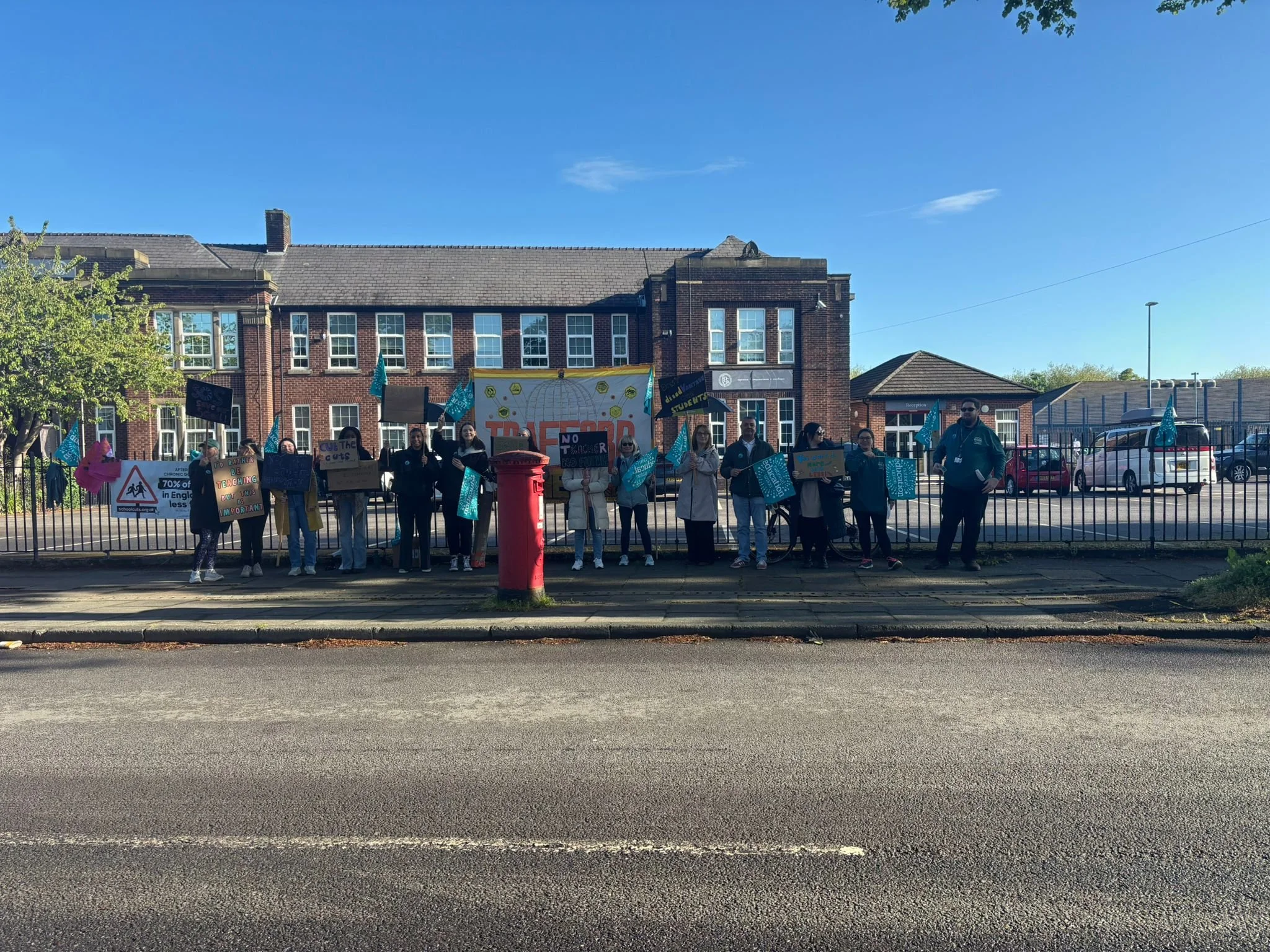
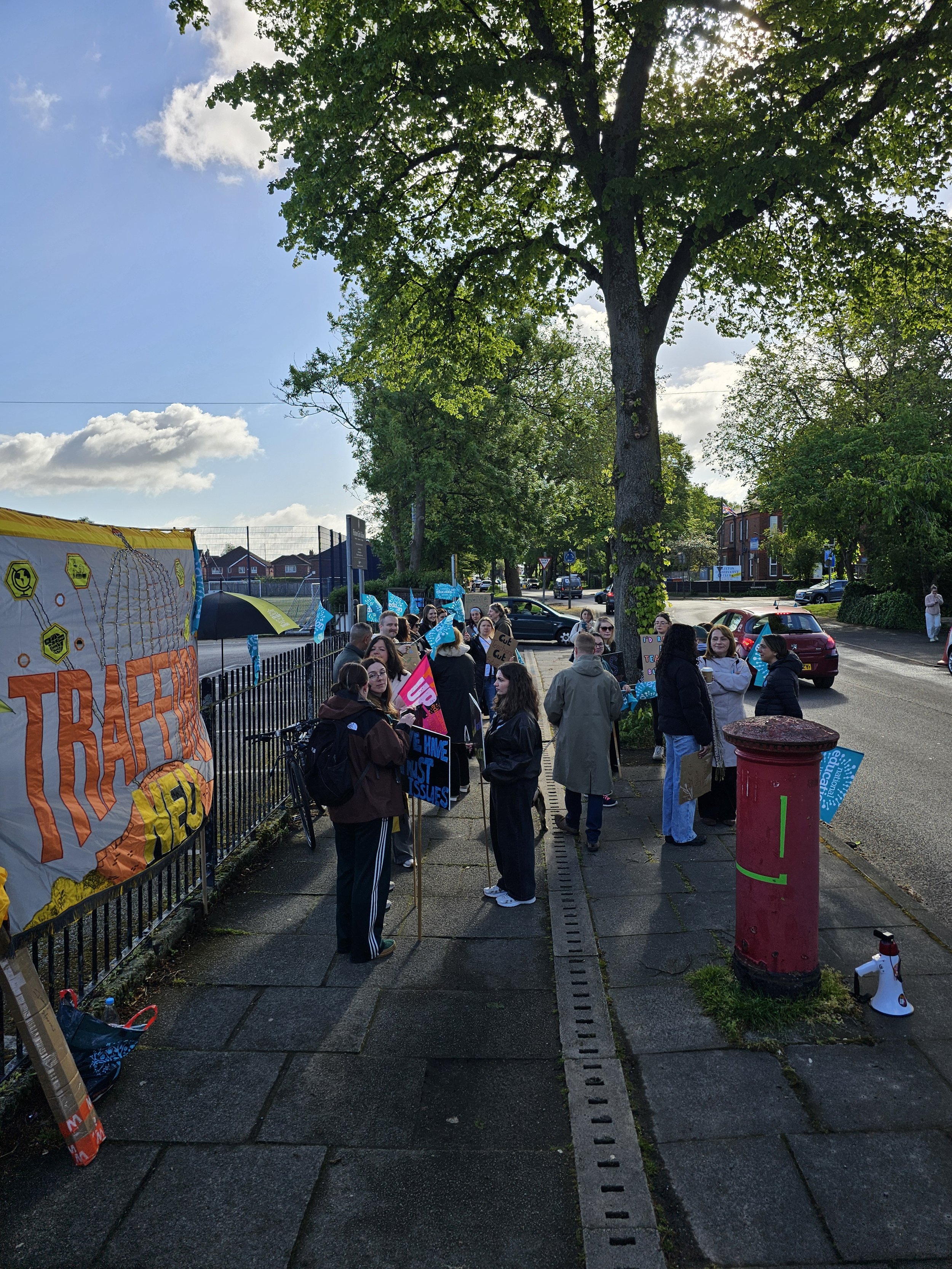
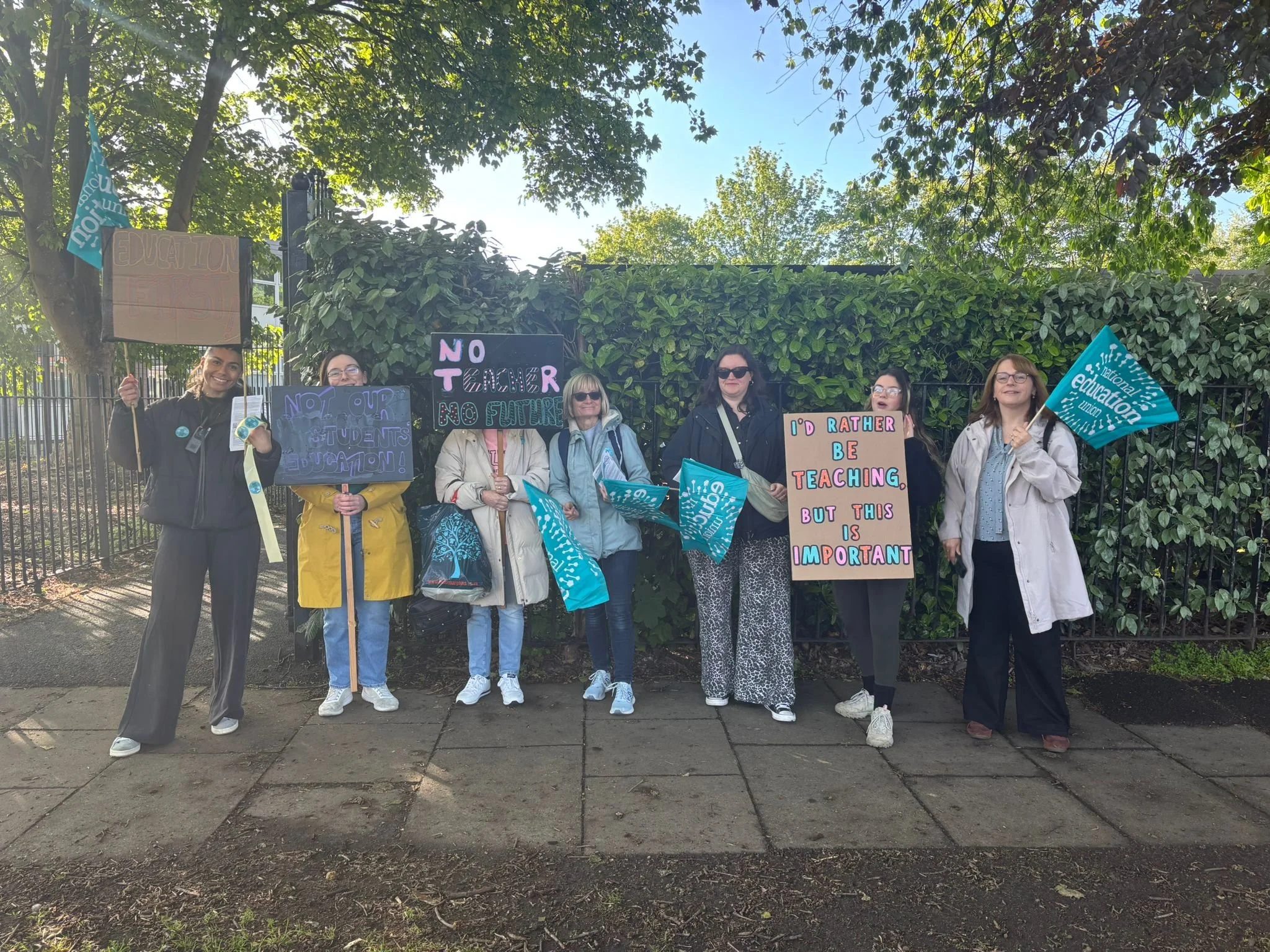
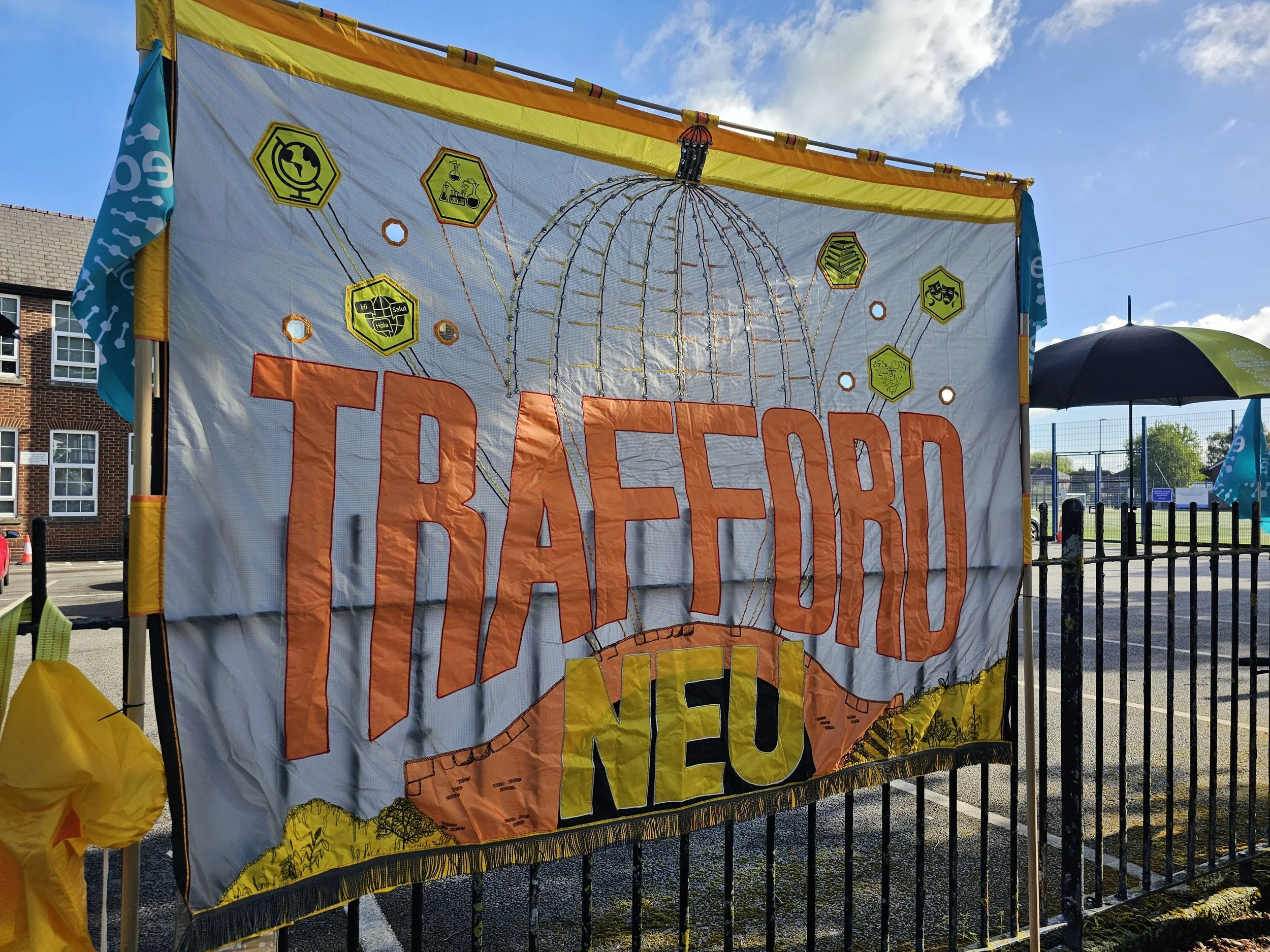
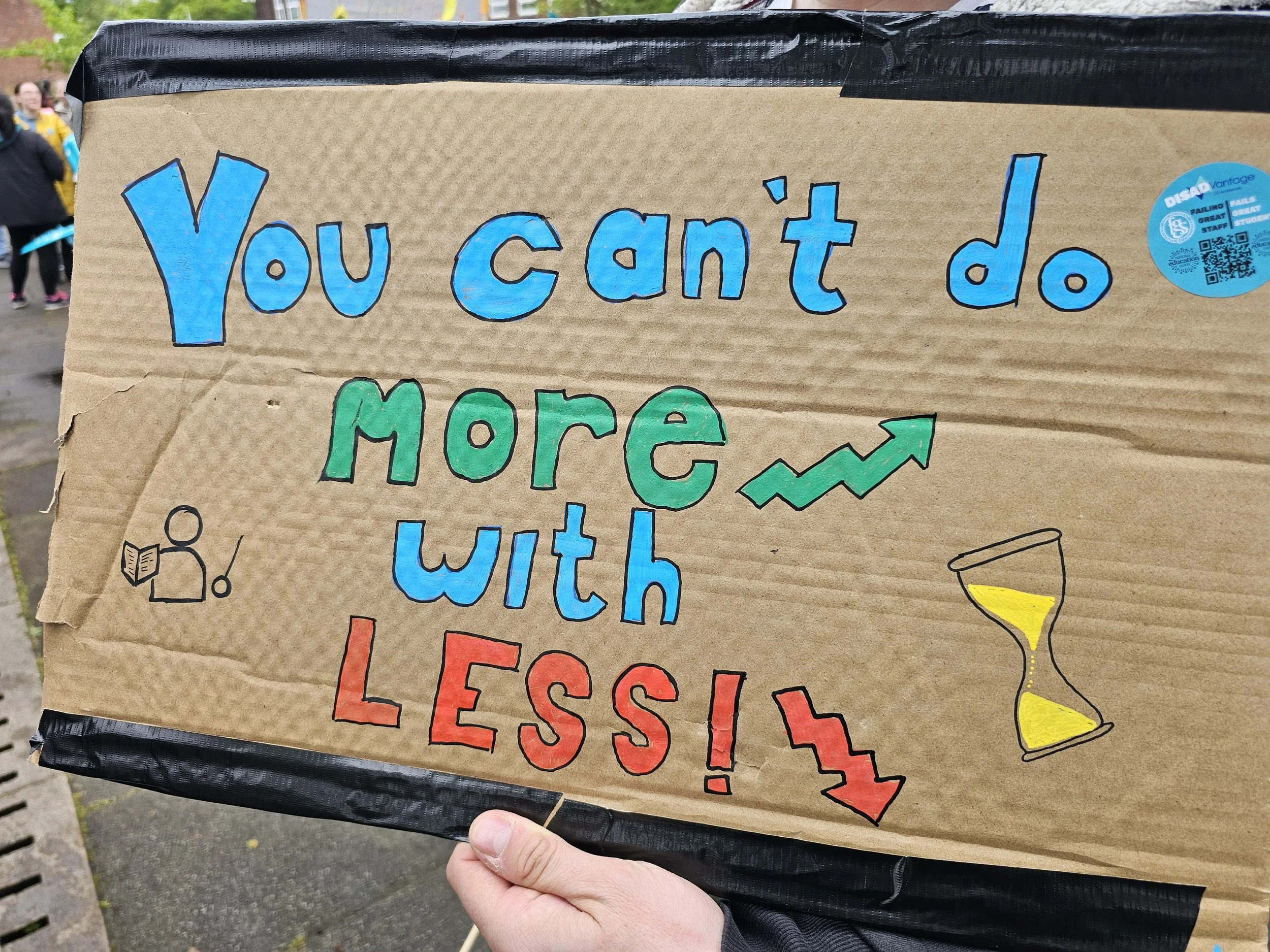
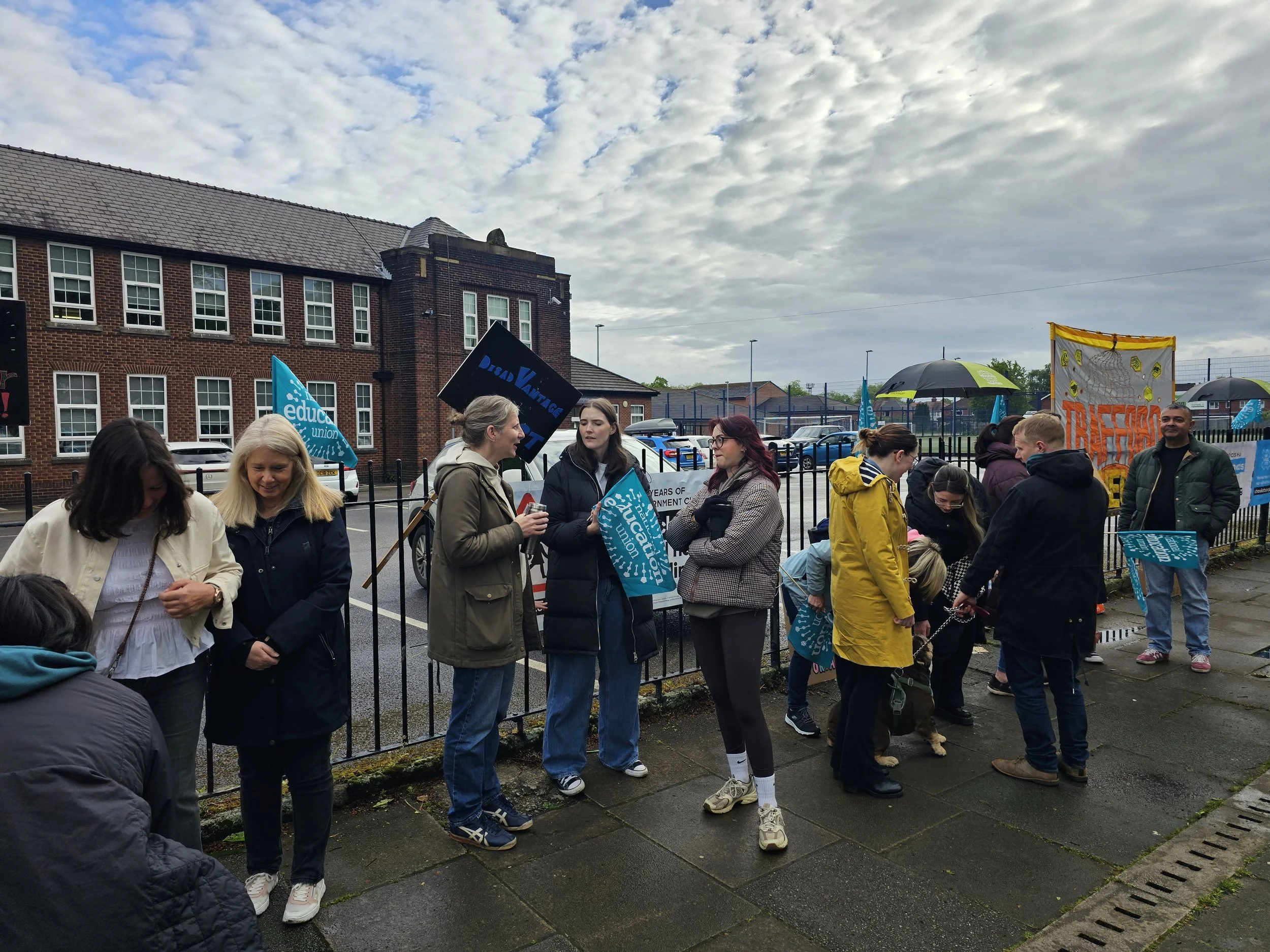
Over 30 NEU Members (and one honorary NEU Dog!) took a stand and took to the picket line for the first of six strike days against the proposed restructure and erosion of subjects at Flixton Girls School.
While the weather was cold, the rain did hold off, and the sun shone brightly on members fighting for the education provision at FGS and for their own and colleagues’ jobs.
As a consideration to the students undertaking their GCSE exams, which were invigilated by external invigilators, we stopped our picket at 9 am to prevent any noise from supportive passersby.
Following the picket, members were well fed and watered at the delightful Lilys at Eden in Urmston, who we thank tremendously for their hospitality and for being able to support us at short notice on a Thursday morning!
Messages of solidarity for those striking came in from: Northern Ireland, Chorley, Warwickshire, Hertfordshire, Croyden, Lewisham, Newham, Brent, Hull, York, Coventry, Worcestershire, Leicestershire, SW Lancs, West Sussex, Camden, Reading, Enfield, Islington, St Helens, Tameside, Knowlsey, Warrington, Bolton, Preston, Manchester, Sefton, Cheshire East, Cheshire West, Fylde & Wyre, Preston and Lancashire, Blackburn with Darwin, Oldham and from Reps all over Trafford not to mention the support from Year 11 Students who were attending for their GCSE exam and from parents at the school.
The next days of strike action are on the 19th and 20th.
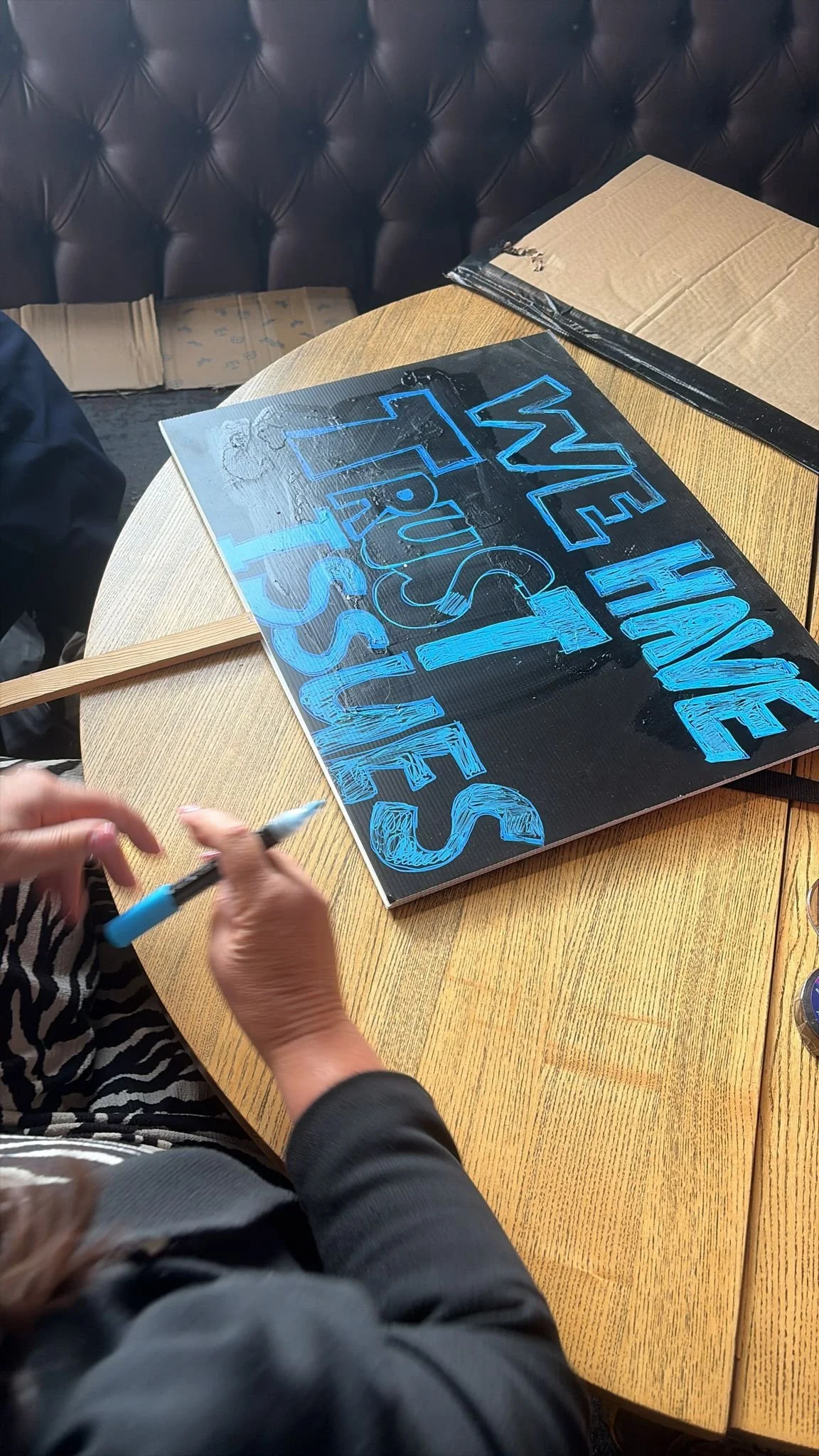


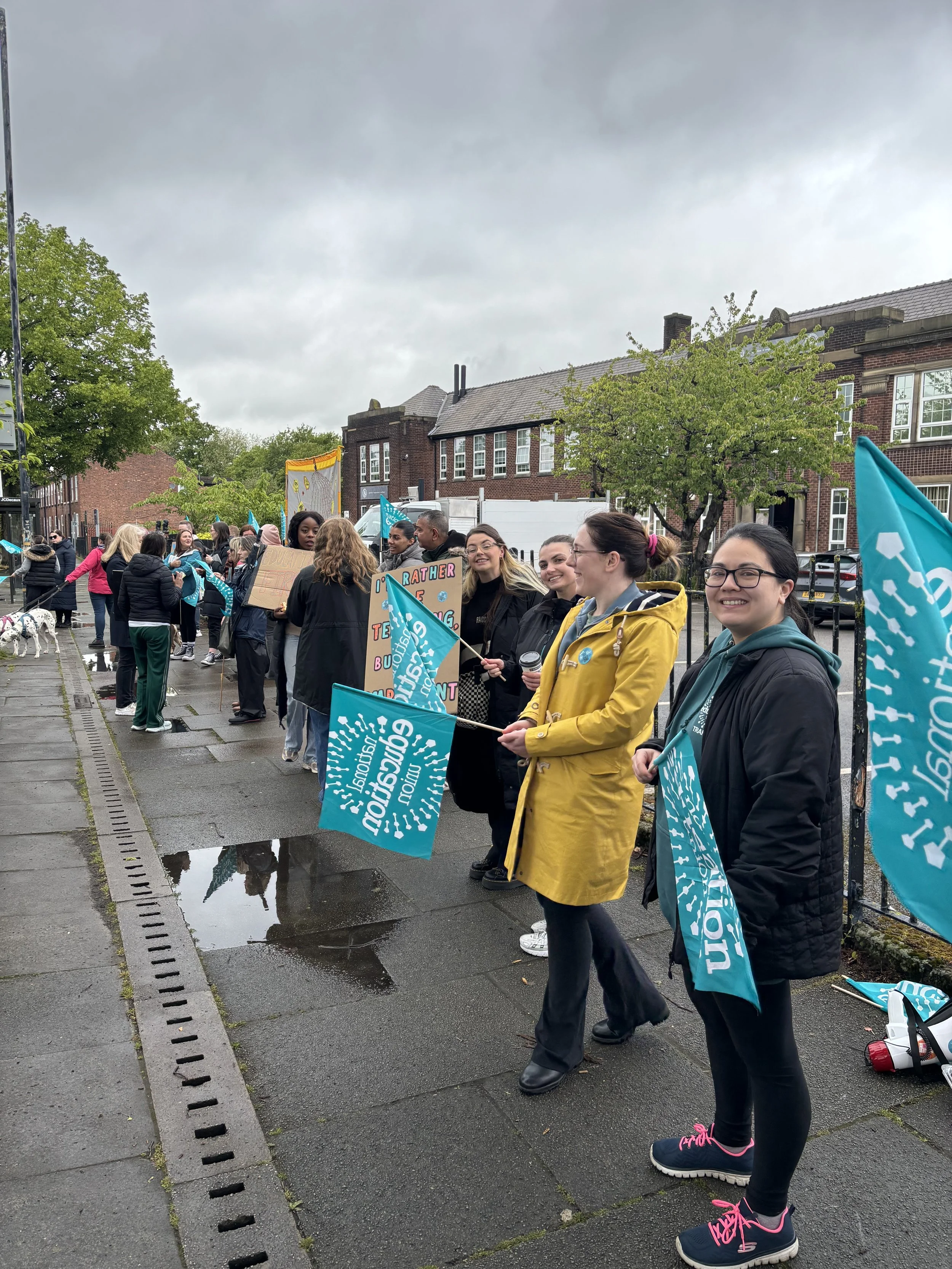
DAY 2 & 3
19th and 20th May:
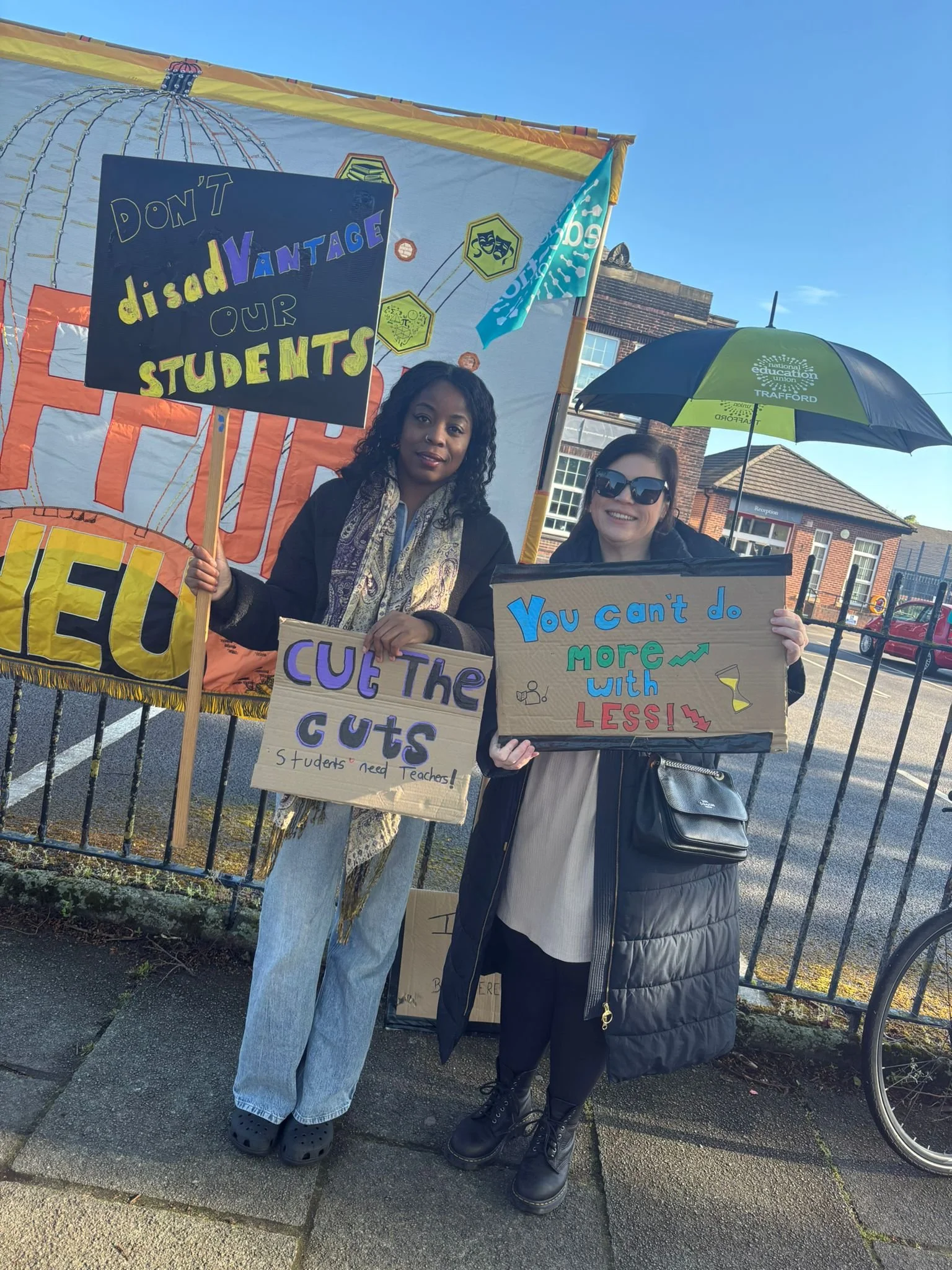
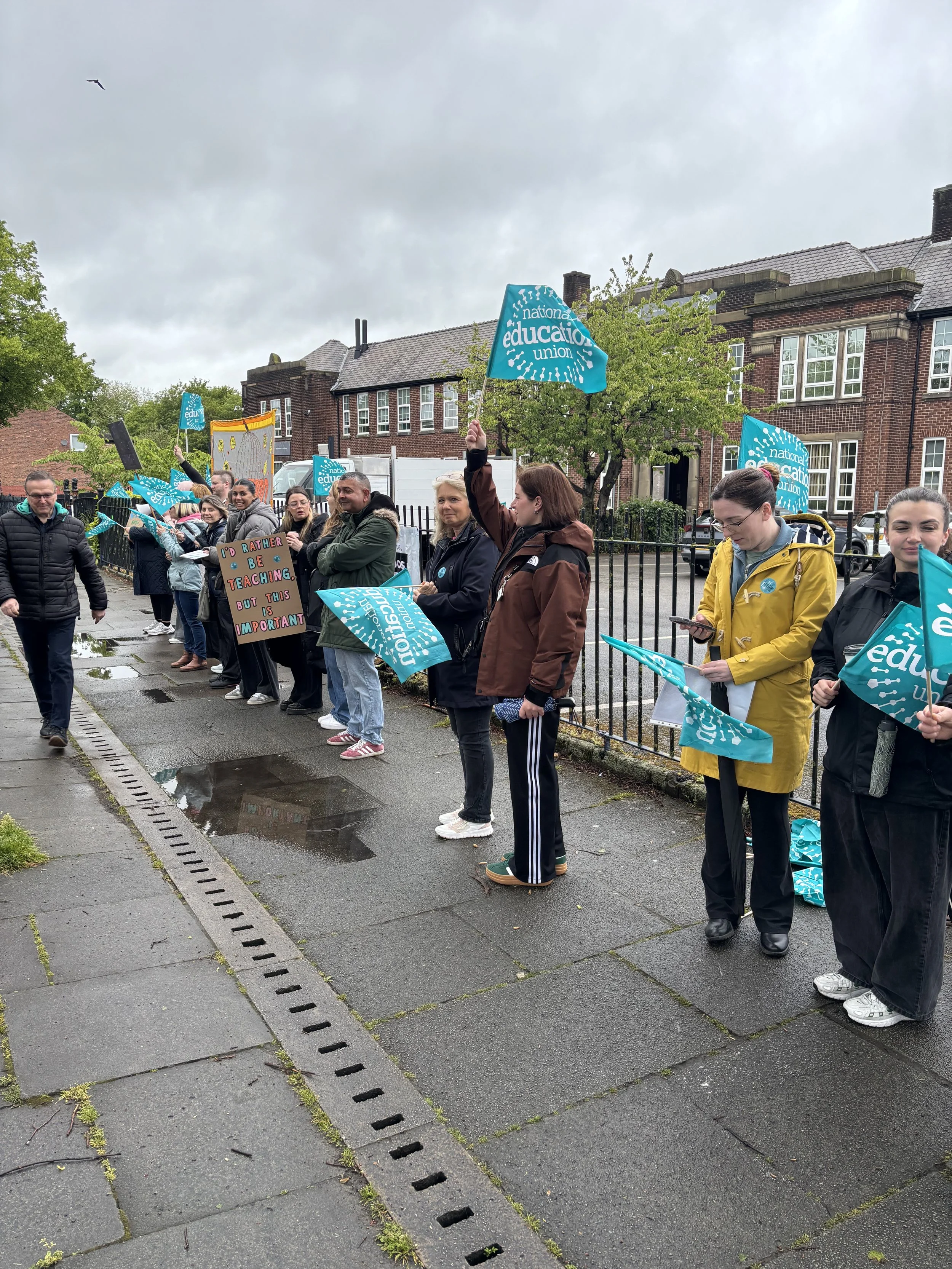
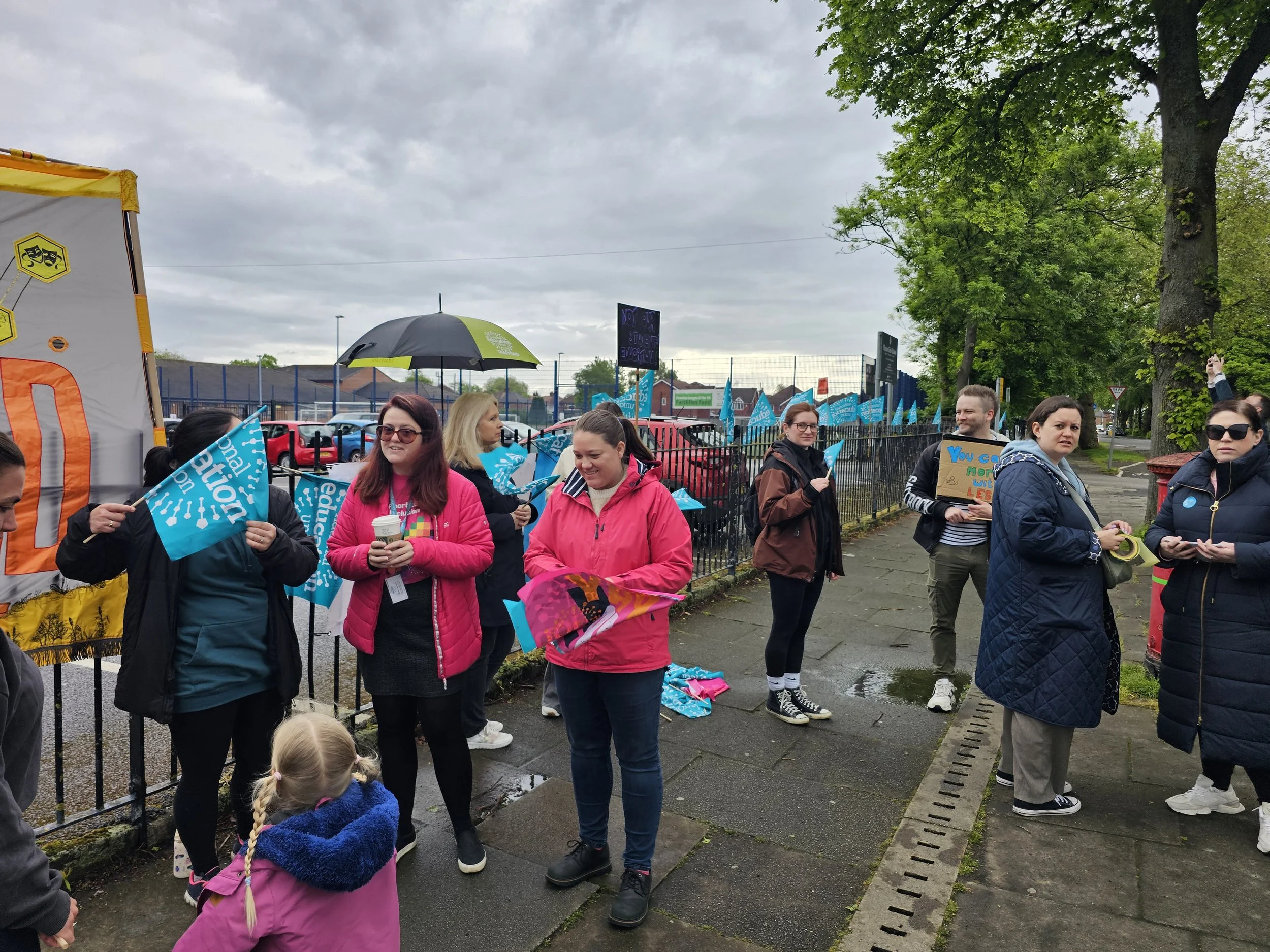
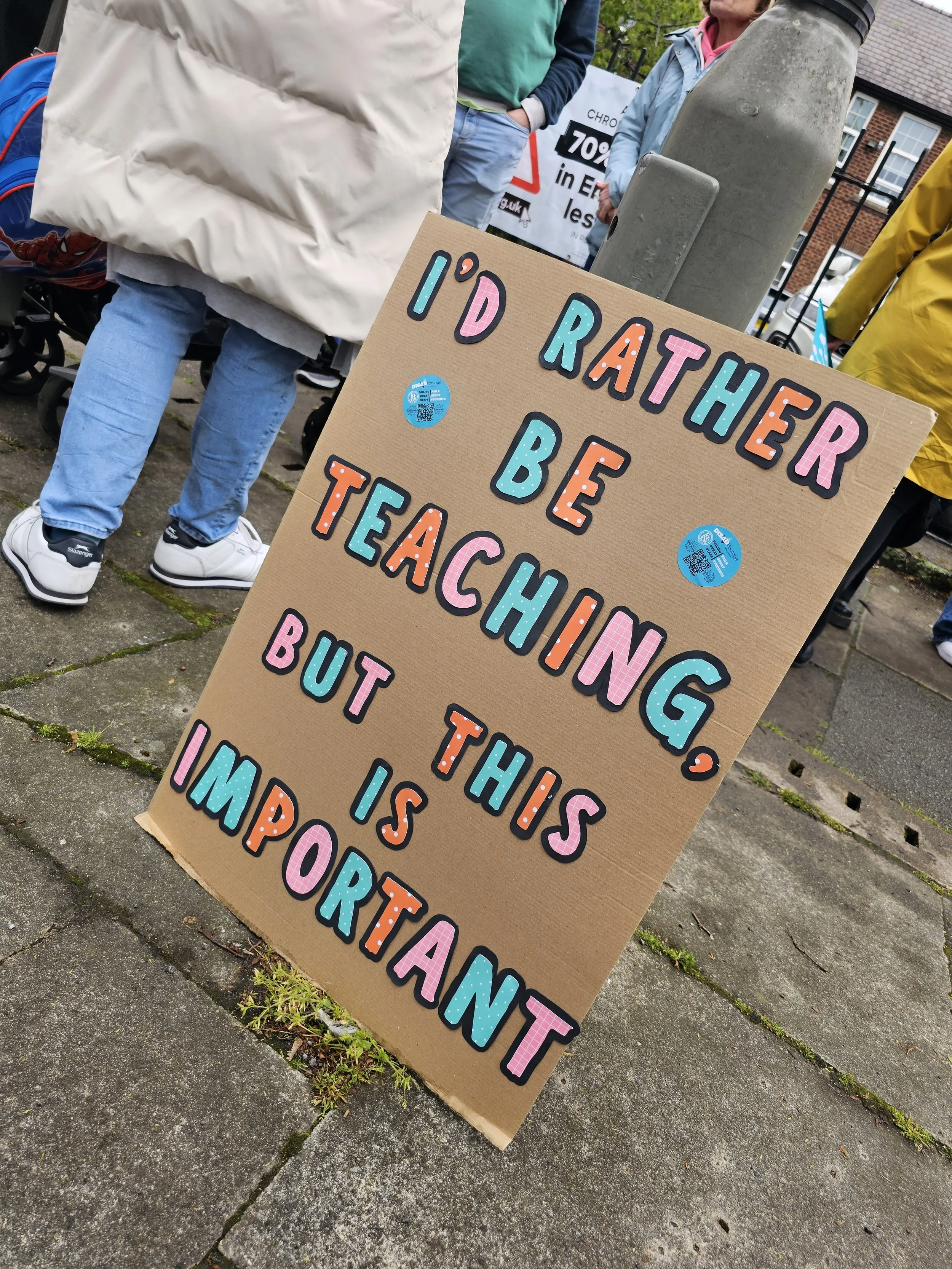
Despite the rain finding us after a long week of threats, the NEU Members proudly returned to the picket line for 2 more days of industrial action. Not deterred by the lack of progress made with negotiations, members remained steadfast in their resolve for clear and meaningful change in a direction which supports members, but the school community as a whole.
Members were a little upstaged, however, by the many strike dogs and young children who loved the atmosphere!
There were many positive interactions with students, parents and members of the public who were interested in why members were striking and outraged at the decisions which have been taken to force them to get to their last resort: strike.




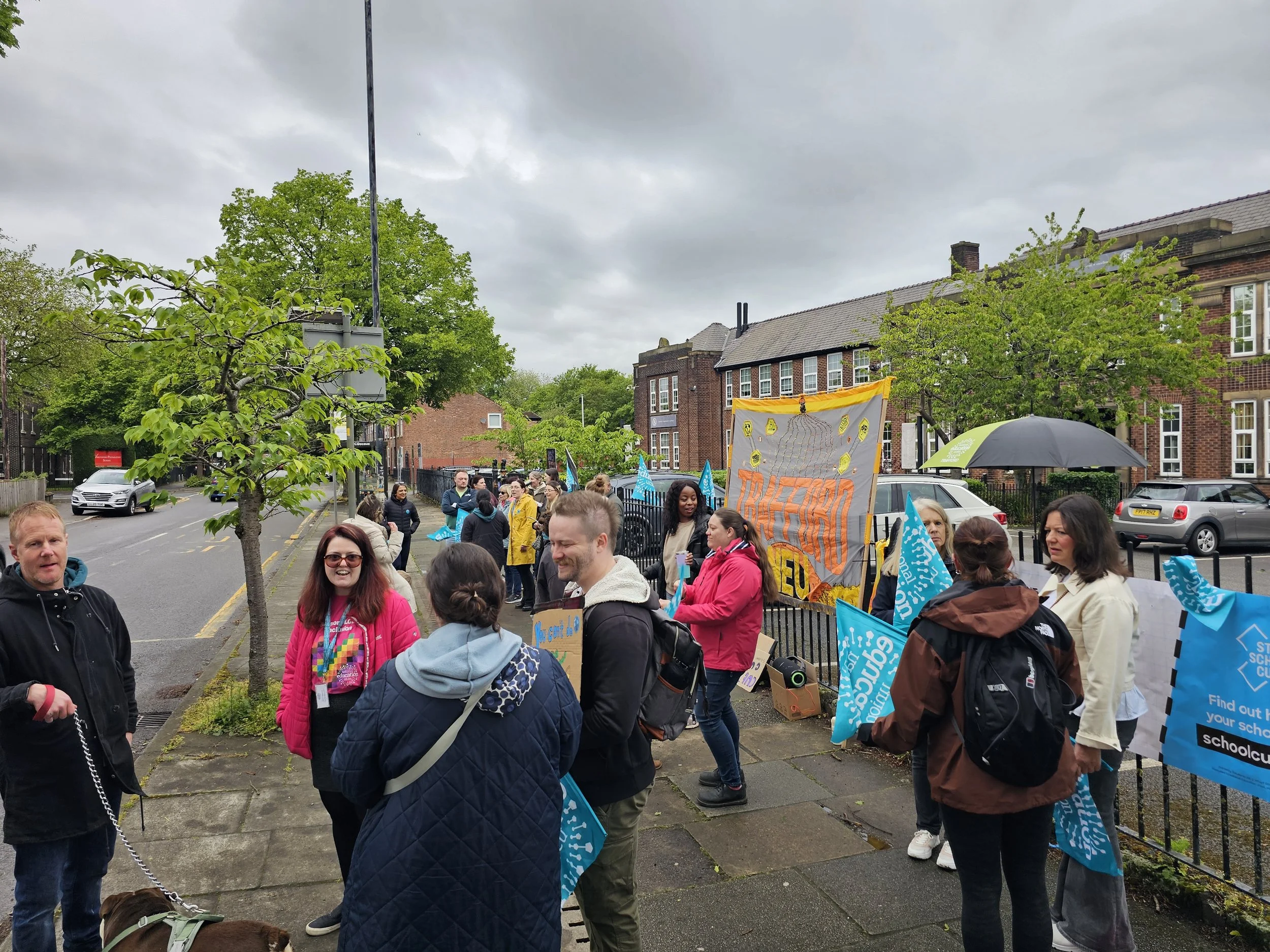



Not all heroes wear capes… but Eevee does!